What film crews can borrow from radio practice
Microphone distance, LUFS loudness measurement, broadcast rules and the station clock: four radio habits a film crew can put to work on set.
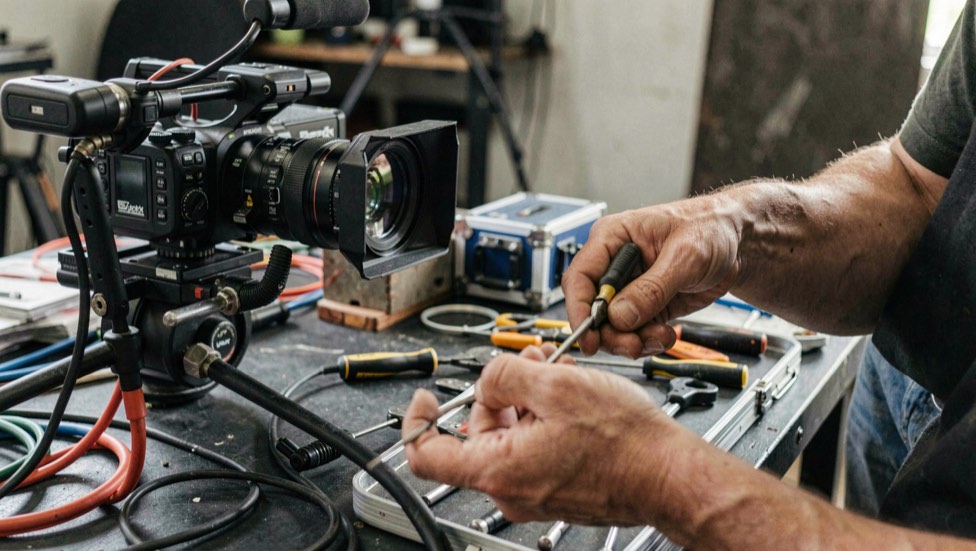
A microphone should sit roughly a hand span from a speaking voice, about 15 to 25 centimetres, and closer still in a noisy room. Loudness is measured in LUFS because the unit describes perceived level over time rather than the peaks a meter needle happens to catch. A film crew can borrow three things from a radio station's working day: a fixed distance for dialogue, a loudness target agreed before the shoot, and a clock that treats every segment as having a start and an end.
01
How far should a microphone sit from a voice?
For a single speaking voice in a quiet interior, 15 to 25 centimetres is the working range. At that distance a cardioid or hypercardioid microphone picks up the voice clearly while the room stays in the background. Move to 40 centimetres and the room starts to arrive in the recording; move to 10 centimetres and plosives, breath and lip noise become part of the take.
Radio studios settled on this range long before film crews borrowed it, and the reasoning is worth keeping. Every doubling of distance costs about 6 dB of direct sound, while the reflected sound in the room falls off far more slowly. The ratio between the two changes, so the voice does not simply get quieter, it gets roomier. That is why a boom operator who cannot get close will often choose a different microphone rather than a different gain setting.
Distance also decides how much of the performance survives. A presenter leaning into a microphone sounds intimate; the same presenter at arm's length sounds like a public address announcement. Film dialogue has the same behaviour. If a scene is written as a quiet exchange, the microphone has to be close enough for the quiet to be usable, otherwise the mixer will raise the whole take and bring the room up with it.
There are practical limits. A boom cannot always enter the frame, and a lavalier sits lower than a hand span by design. In those cases the useful habit is to keep the distance consistent across the scene rather than to chase the ideal figure. A scene recorded at a steady 30 centimetres cuts together far more easily than one that drifts between 10 and 60.
For readers who want the longer explanation of how distance, wiring and level are handled in a broadcast studio, the field notes collected at radio engineering and station operations walk through microphone technique, anti-hum wiring and loudness measurement in plain language. The same physical rules apply whether the microphone feeds a transmitter or a recorder.
02
Why does loudness get measured in LUFS?
LUFS stands for Loudness Units relative to Full Scale. It is a measurement of perceived loudness, averaged over time, rather than a reading of the highest peak in a signal. A peak meter tells you whether a signal will clip. A loudness meter tells you whether a listener will reach for the volume control.
The distinction matters because two recordings can share identical peak levels and still sound wildly different in level. A dense mix with constant energy will sound much louder than a sparse one with the same peaks. Peak metering cannot see that difference; loudness metering is designed to.
The measurement applies a frequency weighting, roughly following how human hearing responds across the spectrum, and it averages over a window of a few hundred milliseconds. Short-term and integrated readings are both used. Integrated loudness covers a whole programme and is the figure usually quoted when a delivery specification says a mix must sit at a particular level.
For a film crew, the useful consequence is simple. Agree a loudness target before the shoot, not after the edit. Dialogue recorded with wildly different levels across a day will need compression and automation to sit together, and that work costs time. A consistent recording level, checked with a loudness meter rather than by ear alone, removes most of it.
It is also worth knowing that loudness normalisation is now standard in broadcast delivery. A programme that arrives too loud is turned down, and one that arrives too quiet is turned up, so the loudest mix no longer wins. The same logic is creeping into streaming delivery for film and television. Mixing to a stated target is more reliable than mixing to taste and hoping.
03
What can a film crew borrow from a radio station's working day?
A radio station runs on a clock. Segments have fixed lengths, the news arrives at a known minute, and the presenter works backwards from the end of the hour. That structure is not bureaucracy; it is what allows a live programme to be made by a small team without constant negotiation.
A film crew can borrow the same idea at a smaller scale. Give each setup a stated duration before it begins. Give each scene a target number of takes. Put the hard stops in the schedule, not the soft ones, and treat the end of the day as fixed. Productions that plan only the start times tend to run long, because nothing in the plan resists the overrun.
Radio also separates preparation from transmission. The material is gathered, checked and labelled before it goes to air, and the live hour is reserved for assembly. On a film set the equivalent is separating the recording of dialogue from the decisions about it. Notes, wild lines and room tone are gathered while the setup is standing, not reconstructed later from memory.
A third habit is the handover. A radio shift ends with a written log: what ran, what failed, what needs attention. A film day ends better with the same document. Camera cards, sound files, batteries and continuity notes all have a location, and the next day starts from a record rather than a conversation.
04
What rules does a broadcaster work under?
Broadcasters operate inside a framework that film crews rarely think about, and some of it transfers. Transmission is regulated: power, antenna height, bandwidth and interference are all constrained by licence conditions. Emergency alerting can interrupt normal programming, and stations are expected to carry it. Recorded material carries its own rights, and a piece of music used in a broadcast may involve more than one copyright.
The transferable lesson is that constraints are designed in advance rather than discovered on the day. A film production has its own constraints: location permissions, noise curfews, child performer hours, insurance conditions. Writing them into the schedule at the planning stage is cheaper than meeting them at 6pm on the second day.
Rights are the other area worth borrowing. A broadcaster knows which recordings are cleared and for how long. A film production that keeps the same discipline, tracking music, archive and contributor clearances as they are gathered, avoids the situation where a finished cut cannot be released because one piece of material was never documented.
05
How does a station's clock shape the work?
A station's day is built from repeating units: the hour, the segment, the link between records. Each unit has a length, and the presenter's job is to fill it exactly. That is a discipline of estimation, and it is learned by doing it repeatedly with a clock in view.
Film scheduling benefits from the same discipline. Estimating how long a scene will take is a skill, and it improves when the estimate is compared with the actual duration afterwards. A production that records planned and actual times for each setup will, within a week, have a realistic picture of what its crew can achieve in a day.
The clock also creates natural checkpoints. A radio hour has fixed points where the presenter can reset. A film day can have the same: after lunch, after the first two setups, at the point where the light changes. Checkpoints let a first assistant director make a decision early rather than at the end of the day, when the options have gone.
None of this requires a film crew to become a radio station. It requires borrowing four habits: a consistent microphone distance, a loudness target agreed in advance, a schedule with hard stops, and a written record at the end of each day. Each one is cheap to adopt and each one removes a class of problem that otherwise gets solved in the edit, at the highest possible cost.

06
Carry the note into the next day
The value of a production note is its second use. Keep the decision, the reason for it and the signal that would make you change it. That short record gives the next person a way to repeat the useful part without repeating every mistake.